


What Roller Skate Plates Should I Use? The Honest Guide


Choosing a roller skate plate can be confusing because every manufacturer describes its products as responsive, precise, lightweight or high performance. Those words sound impressive, but they do not tell you whether the plate will suit your skating. A beginner cruising outdoors, a rink skater working on edges, an artistic competitor and a speed skater all need different things. The best plate is not necessarily the most expensive one. It is the plate with the right size, geometry, adjustment range and mounting position for the person using it.
This is not an exhaustive list of every quad skate plate available. It is a selection of popular plates commonly used across different styles of quad skating. If we have missed a plate that you would like to see reviewed, please let us know. Without further waffle.. Lets get into this!!
What Does a Roller Skate Plate Actually Do?
The plate connects the boot to the trucks, wheels and toe stop, but it also determines much of how the skate responds. Its wheelbase affects stability and manoeuvrability, its kingpin geometry influences how quickly the trucks steer, its cushions control how freely the action moves, and its material affects weight, rigidity and durability. The plate cannot create good technique, but it can make particular movements easier or harder. A responsive plate reacts quickly to small changes in pressure, while a more restrained plate generally requires a more deliberate input from the skater.
The Short Answer
A recreational or beginner skater does not automatically need an expensive metal plate. A good nylon plate such as the Playmaker or Sure-Grip Rock can provide years of enjoyable skating. Skaters wanting greater rigidity, adjustable pivots and more accurate tuning should consider a mid-range aluminium plate such as the Sure-Grip Avanti, PowerDyne Reactor Neo or Pilot Falcon F16. The Sure-Grip Avenger suits people who want a lively 45-degree action, while the PowerDyne Arius Platinum offers an extremely light and direct specialist design. Artistic skaters should seriously consider Roll-Line, while dedicated speed skaters may be better served by specialist Bont or Boen equipment.
Choose the Plate for Your Type of Skating
Start with what you actually intend to do. Recreational, outdoor and casual rink skaters usually benefit from predictable handling, accessible replacement parts and a sensible price. Rhythm and dance skaters may want quicker edge response and a shorter wheelbase. Roller derby skaters often look for agility, strength and secure toe-stop adjustment. Park skaters need durability and compatibility with their preferred blocks, trucks and toe stops. Artistic skaters require precise, repeatable action and discipline-specific equipment, while competitive speed skaters usually favour low kingpin angles, stability and minimal unnecessary weight. Buying a specialist plate simply because it is expensive can leave you with a skate that is completely wrong for your intended use.
Nylon, Aluminium or Magnesium?
Nylon plates are affordable, light and resistant to corrosion, but they can flex more than metal plates, particularly under heavier or highly powerful skaters. Aluminium plates are generally stiffer and provide a more direct connection between the boot and trucks, although construction quality matters more than the word aluminium alone. Magnesium can produce a substantial weight reduction while retaining useful rigidity, but it costs more and will not automatically steer better than the aluminium version of the same design. Material affects weight, rigidity, longevity and price, but the action geometry, cushions, wheelbase and mounting position have a greater influence on how the plate actually turns.
Kingpin Angle and Skate Action
The kingpin angle helps determine how truck movement translates into steering. Lower-angle designs, commonly around 7 to 16 degrees, tend to feel stable and progressive, although cushion choice and setup can still make them highly responsive. Higher-angle systems such as the Sure-Grip Avenger’s 45-degree DA45 action react more quickly to changes in pressure and can feel extremely agile. That does not make one geometry universally better. A low-angle speed plate and a high-angle derby plate are solving different problems, and the quoted angle should never be considered in isolation from the rest of the action.
Single Action and Double Action
A single-action truck traditionally uses one cushion for each kingpin assembly, while a double-action system uses two cushions, normally positioned above and below the truck. Double action provides a broader range of movement and tuning and is now standard on most modern quad plates. A plate being double action does not guarantee that it will be soft or agile because cushion hardness, cushion shape, kingpin angle and adjustment all contribute to the result. Most skaters choosing a new general-purpose plate should select double action unless they have a specific reason to use a traditional single-action system.
Cushions Matter More Than Many Skaters Realise
Modern skate cushions are generally made from urethane and, much like wheels, are available in different hardnesses. They are not simply decorative pieces of rubber. Their hardness, shape and quality have a major effect on steering, stability, rebound and the amount of force required to move the trucks. Firmer cushions resist compression and can initially feel more stable, but they require greater effort to turn the skate. Softer cushions compress more easily, allowing the skater to steer using smaller and more precise weight shifts, although cushions that are too soft for the skater’s weight or ability can feel unstable and encourage overcorrection. Cushions are commonly produced in barrel, conical and manufacturer-specific shapes, and some plates use a combination of different shapes within each truck. Cushion colours are not standardised across the industry, so hardness ratings and manufacturer guidance are more reliable than colour alone. Cushions also lose their rebound with age and use, becoming compressed, cracked or unresponsive. Before replacing an otherwise suitable plate, it is often worth trying the correct cushion hardness for your weight and skating style, then carefully adjusting the action.
Fixed and Adjustable Pivot Pins
The pivot pin connects the opposite end of the truck to the pivot cup and must sit correctly for the action to work as intended. Budget plates commonly use fixed pivots, while many higher-level plates provide adjustable pivot pins. Adjustable pivots allow the geometry to be set accurately after cushion changes or action adjustment, but they introduce another component that must be configured and checked. A pivot set too long can produce unpleasant darting or place unwanted pressure on the assembly, while one set too short may move in and out of the pivot cup. Adjustable is not automatically better if nobody adjusts it properly.
Toe-Stop Compatibility
Check the toe-stop fitting before buying a plate. Many modern plates accept adjustable 5/8-inch threaded toe stops, but some entry-level plates use smaller 5/16-inch fixed toe stops, while dedicated speed and dance plates may have no toe-stop mounting point at all and are described as NTS, meaning no toe stop. Also check how an adjustable stop is secured. Some plates use a locking nut, while others use a clamp or pinch bolt. Park skaters should additionally confirm compatibility with their preferred toe stops and slide blocks rather than assuming every accessory fits every plate.
Plate Size Is Not Boot Size
A size six plate is not automatically intended for a size six boot, and one manufacturer’s size six may bear no relationship to another manufacturer’s size six. The useful measurement is normally the wheelbase, measured from the centre of the front axle to the centre of the rear axle. Sure-Grip specifically advises choosing plate size using axle distance in relation to the ball of the foot and heel rather than relying solely on the number printed inside the boot.
Standard, Sport or Short Forward Mount?
A standard mount uses a wheelbase appropriate to the overall boot length, with the rear axle beneath or close to the centre of the heel and the front axle beneath the ball of the foot. A sport mount sits between a standard and short forward mount, using a slightly shorter plate while keeping the front axle correctly positioned beneath the ball of the foot and bringing the rear axle modestly forward. This increases manoeuvrability without sacrificing as much stability as a full short forward setup. A short forward mount uses an even shorter plate positioned towards the front of the boot, providing maximum agility but less rearward stability. These terms are not applied consistently by every manufacturer or skate builder, so the actual axle positions and wheelbase matter more than the label. A plate that is unnecessarily short can feel nervous, while one that is too long can make the skate reluctant to turn.
Why Mounting Position Matters
From fitting around a thousand pairs of plates, I have found that positioning can affect the finished skate as much as the plate itself. The front axle should normally begin beneath the ball of the foot, with fore-and-aft placement adjusted according to the balance of agility and stability required. Moving the plate forward generally increases agility, while moving it backwards increases stability. Lateral alignment also matters: a slightly more inside-biased position can increase stability, while moving the plate outwards can make inside edges feel lighter. These are fine adjustments, not excuses for mounting a plate visibly crooked. Equal wheel projection, the boot centre line and the skater’s anatomy all need to be considered.
Roller Skate Plates by Manufacturer
Ventronic (Ventro, Ventro Pro)

Ventro Skate is a UK-focused roller-skating brand and supplier closely associated with traditional British quad-skating equipment, including Playmaker plates, Air Waves wheels and Ventro Pro Turbo wheels. Ventro operates within the UK skate market and describes itself as part of UK skate culture. Ventro is best known for affordable, exceptionally durable equipment that works particularly well for rink, recreational and traditional British skating. The Xytel Playmaker reflects that approach perfectly: simple, tough, lightweight and trusted by everyone from beginners to some of the UK's best skaters.

Playmaker
The Playmaker is a 10-degree double-action plate made from Xytel, a glass-fibre-reinforced nylon composite. Its combination of exceptional toughness, low weight, straightforward construction and affordable pricing has made it something of an industry-wide default for quad skate conversions and complete skate builds. It should not be treated as merely a beginner plate. Some of the best chop skaters and fastest backwards skaters in the UK use Playmakers because they can withstand aggressive changes of direction, rapid footwork and sustained high-speed skating without requiring an expensive metal chassis. They are particularly popular within the London chop-skating scene and have also been used successfully on recreational skates, hire skates and ice-hockey boot conversions for many years. Playmakers use alloy trucks with 8mm steel axles and fixed 5/16-inch toe stops rather than the larger adjustable system found on more expensive plates. They do not provide adjustable pivots or the fine tuning of a premium machined plate, but their proven strength and reliability make them a legitimate choice for everyone from first-time skaters to highly skilled skaters.
Sure-Grip

Sure-Grip was founded by John L. Wintz in a small Southern California garage in 1937 after he developed a roller-skate wheel with a rubber inlay to provide more grip than the wooden wheels used at the time. The company remains based in California, where many of its products are still manufactured or assembled, and has grown into one of the oldest and broadest roller-skate component manufacturers in the world. Sure-Grip is particularly good at producing dependable equipment across a huge range of prices and skating styles, from affordable Rock plates to the conventional Avanti and highly responsive Avenger DA45 system. Its long production history, extensive replacement-parts availability and familiar cushion systems make it one of the safest manufacturers around which to build a long-term skate setup.

Sure-Grip Rock
The Sure-Grip Rock is another affordable 10-degree nylon plate, but its 5/8-inch adjustable toe-stop fitting makes it more versatile than the Playmaker for skaters who want to choose their own toe stops or plugs. It provides predictable conventional handling and is light enough for recreational, rink and outdoor builds. The Rock is an excellent example of why nylon should not automatically be dismissed. It will not provide the same rigidity or adjustment as a premium metal plate, but it offers genuine value and suits far more skaters than its modest price might suggest.

Sure-Grip Avanti Aluminium
The Avanti Aluminium is a strong 10-degree double-action plate with adjustable pivots and a conventional, stable steering character. It represents a significant step up from an entry-level nylon plate in rigidity, adjustment and overall construction. Its aluminium build is not particularly light, but it is durable, predictable and versatile enough for rink, derby, outdoor and some park setups. It is a good option for skaters who want a serious metal plate without moving to the rapid response of the Avenger.

Sure-Grip Avanti Magnesium
The Avanti Magnesium retains the Avanti’s 10-degree geometry and conventional handling while reducing weight substantially. It is the more expensive version, but the main benefit is lower mass rather than an entirely different steering system. It is an excellent all-round premium plate for skaters wanting stability, rigidity and reduced weight without adopting a 45-degree action. As with the Avenger range, the Avanti Aluminium and Magnesium should be chosen according to weight, price and appearance rather than expecting the material alone to transform how the trucks steer.

Sure-Grip Avenger Aluminium
The Avenger Aluminium uses Sure-Grip’s 45-degree DA45 double-action system, adjustable pivots, aluminium trucks, hardened 8mm axles and hollow kingpins. It was originally developed around short-track speed skating and later became strongly associated with roller derby. The response is much quicker than a traditional low-angle plate, making it highly agile but potentially intimidating when incorrectly adjusted or mounted. The Aluminium version comes only in black and delivers the essential Avenger experience at a lower price than the Magnesium model.

Sure-Grip Avenger Magnesium
The Avenger Magnesium uses the same 45-degree DA45 design but combines it with a lightweight magnesium baseplate, supplied only in white. The current version includes hollow kingpins, adjustable pivots and Purple 85A Sure-Grip Super Cushions. Red 93A cushions can make the action feel more restrained, Purple provides the standard balance, Yellow 79A is my preferred setup after years of skating the Avenger, and Blue 72A offers extremely soft and agile movement. The Avenger can feel squirrelly when poorly mounted, incorrectly adjusted or paired with an unsuitable boot, but with the right setup it provides smooth, rapid and highly controllable steering.
PowerDyne

PowerDyne is the plate and hardware brand within the Riedell family of skate companies. Riedell was founded by Paul Riedell in Red Wing, Minnesota, in 1945 and remains based there, producing boots, complete skates and components through brands including PowerDyne, Radar and KWiK. PowerDyne is best known for offering a clear progression from affordable recreational plates to sophisticated competition equipment, beginning with the Thrust and Reactor Fuse, moving through the aluminium Reactor range and ending with the unconventional kingpin-free Arius Platinum. Its strongest area is modern performance equipment for derby, rink, rhythm and custom skate builds, supported by the wider Riedell parts and distribution network.

PowerDyne Thrust
The PowerDyne Thrust is an affordable nylon plate commonly supplied on entry-level Riedell packages. It provides a conventional double-action setup and accepts adjustable toe stops, making it a practical starting point for recreational and beginner derby skating. Like other nylon plates, it can flex under heavier or more forceful skaters and does not provide the precise adjustment of PowerDyne’s metal models. It performs the job it was designed for, but anyone commissioning a premium custom build may find that upgrading at the outset provides better long-term value.
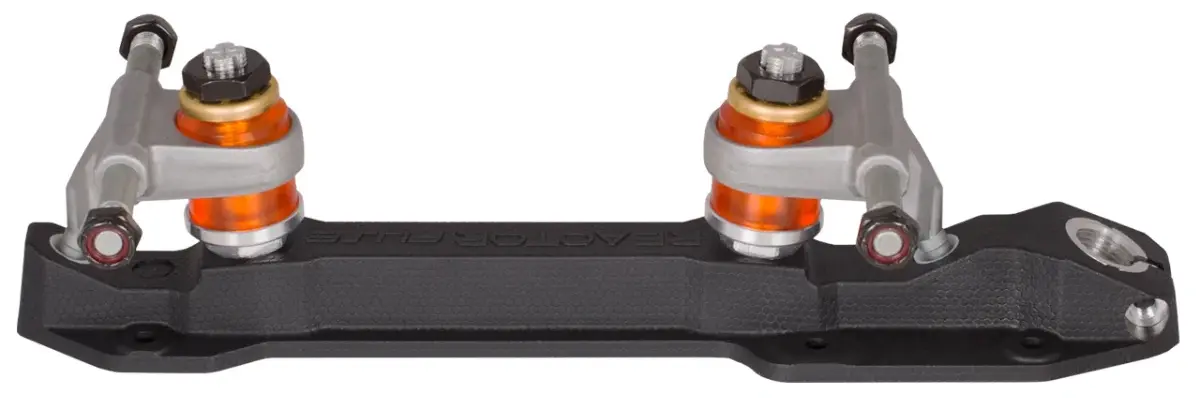
PowerDyne Reactor Fuse
The Reactor Fuse combines a lightweight reinforced-nylon baseplate with design features influenced by PowerDyne’s Reactor range. It sits between basic nylon plates and full metal Reactor models, offering reduced weight and a more performance-focused construction without the price of the Neo. It is attractive for recreational, derby and rink skaters who want something better developed than a basic package plate but do not require a machined aluminium chassis. PowerDyne’s current range places it above the Thrust and below the Reactor Neo.

PowerDyne Reactor Neo
The Reactor Neo is a rigid aluminium plate with a stable 10-degree action, adjustable pivot pins and a secure toe-stop clamp. It is responsive without being excessively nervous and works well for derby, rink, rhythm and general high-performance skating. I have used the Neo on custom ice-hockey boot conversions and consider it a strong all-round option where rigidity, predictable handling and quality construction matter more than achieving the absolute lowest possible weight. It costs considerably more than a nylon plate, but the upgrade is tangible rather than purely cosmetic.

PowerDyne Reactor Pro
The Reactor Pro is the more refined premium member of the conventional Reactor family, using high-quality machined construction and a lightweight, rigid platform. It retains the familiar low-angle steering character rather than trying to imitate the Arius. Availability can vary because the current PowerDyne ranges promoted through different markets do not always list exactly the same models. If considering one, compare its current price directly with the Neo and Arius because it can occupy an awkward middle ground: more sophisticated than the Neo, but without the completely different mechanism that distinguishes the Arius.

PowerDyne Arius Platinum
The Arius Platinum abandons conventional kingpins and instead uses axis pins, winged trucks and split butterfly cushions. It is exceptionally light and provides a direct, immediate response with no kingpin nut to reposition after changing cushions. Once the correct cushion combination has been found, the setup is highly repeatable. It is also expensive and requires experimentation because its action does not feel like a conventional plate. The Arius is not automatically twice as good because it costs more than twice as much as some strong alternatives, but it remains one of the most distinctive and agile premium plates available.
Atom

Pilot plates were developed as part of Atom Skates, an American brand that emerged from the roller-derby resurgence around 2008 and is based in Washington State. Atom began with performance wheels, expanded into Bionic accessories and then introduced Pilot plates to provide strong, lightweight and adjustable hardware for demanding skaters. The business was acquired by Tournament Sports Marketing, owner of Jackson Ultima, in 2012, and the newer versions of the Pilot range are now increasingly branded as Atom plates. The company is best known for roller-derby equipment and practical performance design, with the Falcon F16 providing a responsive 16-degree aluminium system that sits neatly between conventional low-angle plates and more aggressive 45-degree designs.

Pilot Falcon F16
The Pilot Falcon F16 is a precision aluminium plate built around a 16-degree action, placing its steering character between conventional 10-degree plates and highly reactive 45-degree systems. It uses adjustable pivots, one-piece aluminium trucks and a clamped adjustable toe stop. Its mounting slots allow approximately 5mm of lateral positioning, which is extremely useful when aligning the plate and fine-tuning wheel projection. It is a strong choice for derby, rink and dance skaters who want precise response without moving to the more unusual Avenger or Arius systems. Current Falcon 2.0 specifications describe a 16-degree alloy kingpin and one-piece cast aluminium trucks. (Pabloskates)
Roll-Line

Roll-Line is an Italian manufacturer founded in 1999 and operated by T.M. Technology in Villorba, near Treviso. Its products are designed and manufactured in Italy using a combination of modern machining, carefully controlled materials and hand finishing. Roll-Line is best known for artistic roller-skating equipment and has built an exceptional reputation among competitive freestyle, dance, figures and rink-hockey skaters. Its great strength is precision: discipline-specific plate geometry, carefully matched suspension rubbers and click-action adjustment systems allow experienced skaters and coaches to create repeatable setups. Roll-Line does not simply produce progressively more expensive versions of one plate, so the correct model should be chosen for the artistic discipline rather than by price alone.
Why Artistic Skaters Swear by Roll-Line
Roll-Line has built its reputation around artistic roller skating rather than trying to produce one plate for every discipline. Its plates are known for precise edge control, carefully matched suspensions and repeatable adjustment, which matters when a skater is practising figures, turns, spins, jumps and dance movements repeatedly. Roll-Line uses a click-action adjustment system on many models, allowing changes to be counted and reproduced more accurately than simply turning an unmarked kingpin nut. The range can initially appear confusing because different models target different artistic disciplines, and buying the most expensive Roll-Line does not guarantee that it is the correct model for the skater.

Roll-Line Variant M
The Variant M is one of the more accessible Roll-Line artistic plates and uses a metal base with elastomer suspension and click-action adjustment. It provides a proper entry into Roll-Line’s system without the price of its higher-level competition models. It is suitable for developing artistic skaters who want more accurate and repeatable control than a general-purpose recreational plate. The Variant M should be chosen as an artistic tool rather than as a generic upgrade for every kind of quad skating.

Roll-Line Variant C
The Variant C builds on the same general artistic platform but uses upgraded components and cup-style suspension adjustment intended to provide greater precision. It sits above the Variant M and is commonly selected by progressing artistic skaters who require a more refined response. The difference will matter more to someone actively training edges, figures and technical artistic elements than to a casual rink skater circling on a Saturday night.

Roll-Line Blaster
The Blaster is aimed more towards roller derby and dynamic general skating than Roll-Line’s traditional artistic models. It provides the build quality and adjustment associated with the brand but packages it for skaters wanting agility, strength and faster directional changes. It can be a useful bridge for someone attracted to Roll-Line engineering but not practising formal artistic disciplines. Availability and included components can vary, so it is worth checking exactly what is supplied by the UK distributor.

Roll-Line Mistral
The Mistral is a high-level artistic plate intended for demanding freestyle use. It offers more precise construction and response than the Variant models and is commonly selected by serious artistic skaters progressing into advanced technical work. Its cost reflects specialist engineering rather than a universal improvement for all skating styles. A recreational skater may gain little from it, while an artistic skater capable of using its accuracy may consider it money well spent.

Roll-Line Dance
The Roll-Line Dance is designed specifically for dance disciplines, prioritising deep edges, rapid changes and fluid manoeuvrability. Its action can feel extremely responsive compared with a general recreational plate, which is precisely why experienced dance skaters value it. That specialist character also means it should not be purchased merely because it sits near the top of the range. A freestyle jumper, derby skater and dance competitor place very different demands on their plates.

Roll-Line Energy
The Energy is a lightweight high-performance artistic plate available in discipline-specific configurations and intended for advanced skaters. It combines precision construction with a low-mass design, helping reduce the weight being accelerated during complex footwork and jumps. Its benefits are most relevant when the skater already has the technique to exploit them. It is premium competition equipment, not a shortcut past the development work required to become an advanced artistic skater.

Roll-Line Matrix
The Matrix is one of Roll-Line’s flagship competition platforms, using very light and rigid construction aimed at elite artistic performance. It is designed for skaters who need accurate energy transfer, repeatable action and minimal unnecessary weight. Its cost is difficult to justify for casual skating, but that does not make it overpriced for its intended market. Competition equipment should be assessed against the needs of the discipline, not against the price of a recreational nylon plate.

Roll-Line Evo
The Evo sits at the extreme specialist end of Roll-Line’s range and is intended for high-level artistic skating where weight, precision and responsiveness are prioritised over affordability. It is the kind of plate bought because the skater and coach understand exactly why its characteristics are required. Anyone asking whether they need an Evo probably does not need one yet, and there is nothing wrong with that. A Variant or Mistral matched correctly to the skater may deliver a better real-world result than the most expensive model selected without a clear purpose.
Are Roll-Line Plates Suitable for General Rink Skating?
Yes, but suitability depends on the model and the skater. Roll-Line plates can feel superb for rink, rhythm and dance skating because of their accurate edge response and repeatable action. However, parts, toe-stop threads, tools and adjustment systems may differ from familiar American-style equipment, and some models are highly discipline-specific. A general rink skater should choose a Roll-Line because they want its particular feel and engineering, not simply because artistic skaters swear by the brand.
Bont

Bont was founded in Sydney, Australia, in 1975 when recreational short-track speed skater Inze Bont reinforced the back of his leather skates with fibreglass to improve support. That experiment developed into a family-owned international skating company known for heat-mouldable boots, carbon-fibre construction and equipment for ice, inline, quad speed and roller derby. Bont is best at combining low-profile, performance-focused boots with plates designed around speed, derby and powerful skating. Its range spans the affordable composite Prodigy, aluminium Tracer and Athena and the adjustable carbon-fibre Infinity, giving the brand a particularly strong position among skaters who value low weight, rigidity and direct power transfer.

Bont Prodigy
The Prodigy is Bont’s affordable fibreglass-reinforced nylon plate and is commonly supplied on entry-level derby packages. Its 20-degree-style action provides more steering response than many traditional 10-degree nylon plates while keeping the price and weight manageable. It is appropriate for beginners and developing skaters, although powerful or heavier skaters may eventually prefer the rigidity of a metal plate. It should be viewed as a capable package plate rather than the final word in Bont performance.

Bont Tracer
The Tracer range uses aluminium construction and is available in versions aimed at derby or speed skating. This distinction matters: the derby-oriented Tracer and the low-angle NTS speed version are not interchangeable answers to the same question. Bont describes its Tracer plate as an affordable extruded 6061-aluminium option, while its 7-degree speed configuration prioritises stability at high speed. Check the exact model, toe-stop provision and kingpin geometry before ordering rather than relying on the Tracer name alone.

Bont Athena
The Athena is Bont’s premium 6061-aluminium derby plate, using a low-profile construction and 20-degree action intended to balance stability with manoeuvrability. It includes Bont’s ToeGo toe stop and offers more precise construction than the Prodigy or Tracer. It makes sense for committed derby skaters and anyone wanting a rigid, responsive Bont setup, but it is less compelling for someone whose skating style would be better served by a traditional 10-degree plate or a specialist speed design.

Bont Zeus Forged Carbon NTS
The Bont Zeus Forged Carbon NTS is an uncompromising speed-skating plate built around an exceptionally light and rigid forged-carbon chassis. Its low 7-degree action prioritises stability, efficient power transfer and precise control at high speed rather than the deep, highly reactive turning associated with derby or dance plates. It uses double-barrel cushions, 8mm quick-release clip axles and no toe-stop mounting, with NTS meaning “no toe stop”. Earlier versions are instantly recognisable by their gold-coloured trucks, while current versions are generally supplied with black trucks. The Zeus Carbon is one of Bont’s most distinctive and expensive plates, but it is a highly specialised piece of racing equipment rather than a premium plate for every discipline. It is best suited to serious speed skaters who understand exactly what its low-angle geometry and toe-stop-free design are intended to achieve.

Bont Infinity
The Infinity is a specialist carbon-fibre plate with an adjustable-length design, allowing its wheelbase to be configured rather than being permanently fixed by the baseplate. Bont describes it as the first mass-produced adjustable plate of its type. This gives experienced skaters and fitters unusual control over the relationship between boot length, axle position and wheelbase, but it also raises the price and complexity substantially. It is a specialist tool for people who understand why they need that adjustment, not the obvious default for a first custom build.
Boen

Boen is an Italian speed-skating manufacturer whose history began with Enzo Boiani building skates near Pesaro after the Second World War, initially using aluminium recovered from aircraft wreckage and rubber from military vehicle tyres. In 1974, Enzo created the BOEN name from BOiani ENzo, and the company became internationally respected for extremely light and precise racing plates. Boen remains based in the Pesaro area and is now managed by the next generation of the Boiani family. Its specialist field is speed skating, particularly low-angle quad plates made from high-grade 7075-T6 aluminium. The company is also famous for developing quick-release axle systems, a feature continued by the modern Speed Pro Elite QRS. Boen is not trying to provide a plate for every skater; it produces dedicated racing equipment for people who prioritise speed, stability, efficient power transfer and rapid wheel changes.

Boen Speed Pro Elite
Boen’s current quad plates are designed specifically for speed skating and revive characteristics from the company’s influential speed equipment of the 1980s. The Speed Pro Elite uses aerospace-grade 7075-T6 aluminium, 7mm steel axles, a low 7-degree double-action system and a numbered steering adjuster with a locking screw. This is dedicated speed equipment with no conventional toe-stop mounting, not an all-purpose plate for recreational, park or derby skating. Its geometry prioritises stability, efficiency and controlled response at speed.

Boen Speed Pro Elite QRS
The QRS version adds Boen’s quick-release wheel system, allowing wheels to be removed without conventional axle nuts. This is valuable to competitive speed skaters who change wheels for different surfaces or conditions and want to do so quickly. The plate also accommodates wheels up to 85mm and provides alternative front mounting positions. The SL version offers the same core plate with conventional threaded axles and self-locking nuts, so the choice should be based on whether the quick-release system provides a genuine benefit to the skater.
What About Other Plate Manufacturers?
This guide covers the plates I most commonly encounter or consider relevant to Pabloskates builds, but it is not an encyclopaedia of every quad plate ever made. Snyder, STD, Komplex, Crazy, Chaya, Sunlite and several other manufacturers produce worthwhile equipment, while vintage plates continue to have dedicated followers. If I have missed a popular current plate, let me know. I can research it, add it to the guide and, where possible, include real fitting or skating experience rather than repeating the manufacturer’s advertising.
Do Expensive Plates Make You a Better Skater?
No. A better plate can reduce weight, improve rigidity, offer more accurate adjustment and provide an action better suited to your technique, but it cannot create balance, edge control or confidence. Moving from a poor or unsuitable plate to the correct one can make a noticeable difference. Moving from a good £200 plate to a £400 specialist plate may produce a much smaller improvement. Spend more when the additional features solve a real problem or support your discipline, not because the highest price must mean the best skating.
Should Beginners Avoid Responsive Plates?
Not necessarily. A responsive plate is not inherently dangerous or reserved for experts, but it demands accurate inputs. Beginners often make larger corrections than necessary, which can cause a soft or high-angle setup to feel as though it has a mind of its own. Starting with firmer cushions or a slightly tighter action can make the transition manageable, followed by gradual adjustment as control improves. The correct boot, plate size and mount remain essential. My first Avenger build felt chaotic partly because of the overall setup, while the same plates mounted to better-suited boots became some of my favourite skates.
What Plates Does Pablo Use?
For agile rink skating, one of my favourite setups remains the Sure-Grip Avenger Magnesium fitted with Yellow 79A Super Cushions. I have skated that combination for several years and find it provides the right balance of agility and stability for me. I also rate the Reactor Neo as a predictable premium all-rounder and recognise that the Arius Platinum feels incredibly light and directly responsive, although its price and unusual cushion system make it a specialist choice. My preference does not mean everyone should buy an Avenger. Plate feel is highly subjective, and my setup reflects my skating, experience, boots and mounting preferences.
What Plate Should You Actually Buy?
For an affordable conversion or first skate, choose the Ventro Playmaker if a fixed toe stop is sufficient, or the Sure-Grip Rock if you want a 5/8-inch adjustable stop. For a conventional metal upgrade, consider the Sure-Grip Avanti Aluminium or PowerDyne Reactor Neo. Choose the Avanti Magnesium when you want traditional handling with less weight, the Avenger when you specifically want fast DA45 steering, and the Pilot Falcon F16 when you want a precise middle ground. The Arius Platinum suits skaters seeking an extremely light, direct and unusual premium action. Artistic skaters should choose within the Roll-Line range according to their discipline and coaching, while dedicated speed skaters should investigate Bont’s low-angle speed plates or the Boen Speed Pro Elite.
Final Verdict
The right roller skate plate is the one that suits your skating, not the one with the most impressive price or specification sheet. Geometry, wheelbase, cushions, adjustment and mounting position matter more than brand prestige. Nylon is sufficient for many skaters, aluminium provides useful rigidity, magnesium reduces weight, and specialist carbon or machined systems make sense only when their particular advantages are needed. Decide what you want the skate to do, choose the correct size and have it mounted accurately. A modest plate installed properly will outperform an expensive plate chosen and mounted badly.
A Note on These Recommendations
This guide combines manufacturer specifications with my own experience of fitting, adjusting and skating quad plates. Plate feel is subjective and can change significantly with the boot, wheelbase, mounting position, cushions, skater weight, technique and intended discipline. My recommendations are intended to explain the practical differences and help narrow the options, not declare one plate universally superior to every other plate.
Ready to Choose Your New Roller Skate Plates?
Whether you need an affordable and dependable plate for a first custom build or a lightweight performance setup for speed, derby, rhythm or rink skating, Pabloskates can help you choose the correct model, size and mounting position for your boots and skating style. Browse our available plates using the link below, or contact us if you are unsure which option will work best for your build.


Comments