


Sure-Grip Avenger vs PowerDyne Arius Platinum: Which Roller Skate Plate Is Better?


Its the one youve all been waiting for... The 45 degree plate stand off!
The Sure-Grip Avenger and PowerDyne Arius Platinum are both premium, highly responsive roller skate plates, but they achieve that responsiveness in completely different ways.
The Avenger takes the traditional roller skate plate design and makes it considerably more agile through its DA45 truck geometry. It still uses kingpins, cushions, pivot pins and adjustment nuts, so anybody familiar with conventional skate plates will recognise how it works.
The Arius Platinum abandons the traditional kingpin system entirely. Its trucks rotate around axis pins and use PowerDyne’s unusual Split Butterfly Cushions to control movement.
One is an aggressive development of a familiar design. The other is a complete rethink of how a roller skate truck should work.
So, is the PowerDyne Arius Platinum genuinely worth more than twice the price of an Avenger Magnesium, or does the Avenger provide everything most skaters actually need? Lets get into it!
Quick Comparison
Feature | Sure-Grip Avenger | PowerDyne Arius Platinum |
Basic design | Traditional double-action kingpin plate | Kingpin-free axis-pin system |
Plate material | Aluminium or magnesium | 6061 heat-treated aluminium |
Available colours | Aluminium only in black; Magnesium only in white | Platinum-gold anodised finish |
Action | Sure-Grip DA45 | Progressive lateral action |
Adjustment method | Kingpin nuts, pivot pins and cushions | Split Butterfly Cushion selection |
Standard cushions | Purple 85A Super Cushions | Four cushion hardnesses included |
Axles | Hardened steel 8mm axles | Chromoly steel 8mm axles |
Adjustable pivots | Yes | No conventional pivot pins |
Toe-stop mounting | 5/8-inch adjustable toe stop | 5/8-inch adjustable toe stop with separate clamp |
UK price at Pabloskates* | Avenger Magnesium £189.95 | Arius Platinum £424.99 |
Best suited to | Skaters wanting agility with conventional adjustability | Skaters wanting a direct, specialised premium system |
*Prices correct at the time of writing and subject to change.

How the Sure-Grip Avenger Works
The Avenger uses Sure-Grip’s DA45 double-action truck design.
It has the recognisable components found on a conventional roller skate plate:
Kingpins
Kingpin adjustment nuts
Upper and lower cushions
Cushion retainers
Adjustable pivot pins
Pivot cups
The difference is the geometry.
The DA45 action responds much more readily to changes in pressure than a conventional 10 or 15-degree plate. It requires less effort to initiate a turn and allows the skater to produce deep edges and fast changes of direction.
The current Avenger Magnesium is supplied with Purple 85A Sure-Grip Super Cushions, arranged as four barrel and four conical cushions across the pair of plates.
The Purple cushions provide a good balance of movement and resistance, which is why most skaters simply leave them fitted. However, the action can be changed considerably by fitting a different cushion hardness.
Red 93A cushions provide the firmest and most restrained action.
Purple 85A cushions provide the standard all-round setup.
Yellow 79A cushions produce greater agility while retaining useful stability.
Blue 72A cushions are extremely soft and provide the greatest movement.
The kingpin nuts then allow the compression of those cushions to be fine-tuned.
This gives the Avenger a large adjustment range. A skater can start with firm cushions and a relatively restrained setup, then gradually release more movement as their confidence and technique develop.

How the PowerDyne Arius Platinum Works
The Arius Platinum has no conventional kingpins, kingpin nuts or cushion retainers.
Instead, each truck rotates around an axis pin and presses against two Split Butterfly Cushions. These specially shaped urethane cushions fit inside the truck body and control its lateral movement.
PowerDyne describes this as Progressive Lateral Movement. Rather than twisting around a conventional kingpin and compressing a stacked pair of cushions, the truck pivots around its axis while progressively loading the butterfly cushions.
The result is a very direct connection between the skater’s movement and the truck.
There are no kingpin nuts to tighten or loosen. Once the selected cushions have been fitted and the axis pin has been correctly installed, there is no conventional action adjustment to make.
However, that does not mean the Arius has only one setting.
Its action is tuned by changing the Split Butterfly Cushions themselves. The available hardnesses run from very soft 71A Orange cushions through to firm 95A Hot Pink cushions.
The Arius Platinum is supplied with four complete cushion sets:
Aqua 74A
White 80A
Yellow Green 86A
Red 92A
The Yellow Green 86A cushions are normally pre-installed.
Different cushion hardnesses can also be combined within the trucks, providing additional tuning possibilities. This gives the Arius a substantial adjustment range, but changing its behaviour involves removing the trucks and replacing or mixing cushions rather than simply turning an adjustment nut.

How Do They Feel to Skate?
Both plates are agile, but their movement does not feel identical.
Sure-Grip Avenger
The Avenger has a lively, flowing action.
Pressure through the boot compresses the cushions and moves the trucks in a way that remains recognisably similar to other double-action plates. The major difference is how quickly and deeply the DA45 geometry responds.
A poorly adjusted Avenger can feel squirrelly, particularly to someone moving from a stiff 10-degree plate. That does not necessarily mean the plate is unstable. It often means the skater is overcorrecting because the Avenger is responding to movements their previous plates ignored.
Once correctly adjusted and understood, it can deliver:
Fast turns
Deep edges
Easy carving
Smooth direction changes
Strong manoeuvrability
A lively, flowing sensation beneath the foot
The cushion compression also provides some of the familiar spring and suspension associated with conventional double-action plates.
PowerDyne Arius Platinum
The Arius feels more direct and mechanically precise.
Because its truck rotates around a fixed axis pin rather than a kingpin and pivot arrangement, there are fewer conventional adjustment components between the skater’s input and the resulting truck movement.
The action is still controlled by urethane cushions, but the way those cushions are loaded is different. It tends to feel immediate, positive and efficient rather than soft or traditionally springy.
The Arius can offer excellent stability and agility simultaneously, but choosing the correct butterfly cushions is crucial. A cushion set that is too firm may make an expensive plate feel disappointingly restricted. A setup that is too soft can provide more movement than the skater is ready to control.
It can take considerable experimentation to find the ideal combination.

Which Plate Is More Adjustable?
This depends on what type of adjustment you prefer.
The Avenger offers continuous mechanical adjustment. Its kingpin nuts can be moved in small increments, allowing the skater to gradually increase or reduce cushion compression.
Its pivot pins are also adjustable and must be set so that the ball of each pin rests correctly in its pivot cup.
The Arius does not provide this type of incremental mechanical adjustment. Its action is changed by selecting a different cushion hardness or combining different Split Butterfly Cushions.
In simple terms:
The Avenger is adjusted with cushions, kingpin nuts and pivot pins.
The Arius is tuned primarily through cushion selection.
The Avenger is easier to alter in tiny increments. The Arius provides a repeatable setup once the preferred cushion combination has been found.

Which Is Easier to Set Up?
The Avenger is more familiar but has more individual adjustments.
The pivot pins must be correctly positioned, the kingpin nuts must apply suitable pressure to the cushions and all four trucks should be set consistently.
This is not particularly difficult, but it requires some understanding. Incorrect pivot adjustment can cause unwanted movement or an unpleasant darting sensation.
The Arius has fewer adjustable components. There are no pivot pins or kingpin nuts to balance. Fit the selected butterfly cushions, reinstall the trucks and fully tighten the axis pins.
That sounds easier, and mechanically it is. However, finding the correct butterfly cushion setup can involve repeated dismantling and testing.
The Arius therefore has a simpler final setup but potentially a longer experimentation process.
Cushion Changes
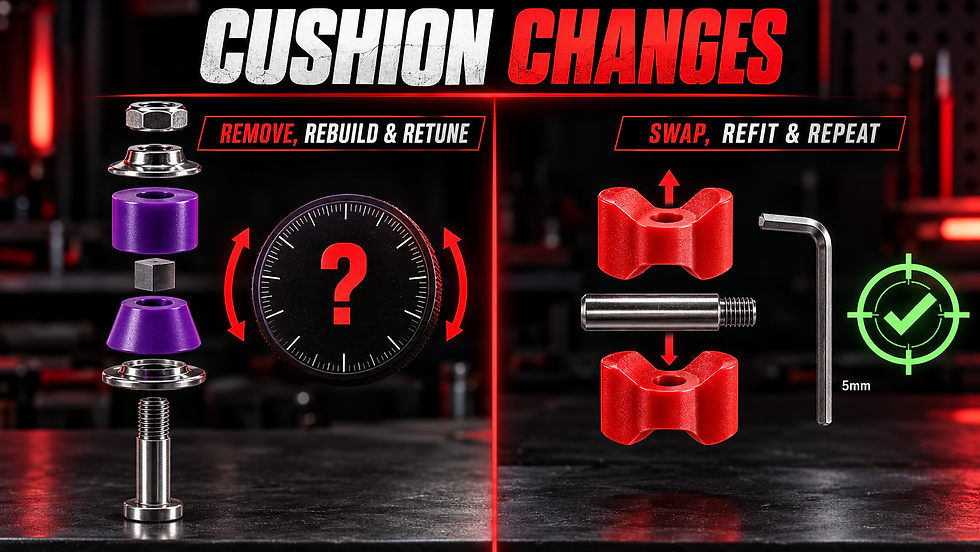
Changing the cushions on an Avenger is much like changing them on most conventional plates. Remove the kingpin nut and cushion retainers, replace the cushions, reassemble the truck and readjust the action.
The drawback is that removing the kingpin nut loses its previous position. Unless you carefully mark or measure the original setting, you will need to spend time skating and making small adjustments to get it feeling exactly as it did before. Mildly annoying, to say the least, which is why I prefer not to disturb the setup on mine unless I genuinely need to.
Changing the cushions on an Arius requires the axis pin and complete truck assembly to be removed. The two halves of the Split Butterfly Cushion can then be slid into or out of the winged truck body.
The Arius Platinum’s redesigned winged trucks securely retain the cushions without requiring kingpin nuts, retainers or any other action-adjustment hardware. Once you have found the cushion combination that works for you, it can be removed and refitted without having to recreate a precise kingpin-nut position afterwards.
That makes the Arius setup highly repeatable. Fit the same cushion combination correctly, fully tighten the axis pins and the action should remain consistent. There is no risk of one truck feeling different simply because its kingpin nut is a quarter-turn away from its previous position.
PowerDyne recommends replacing Split Butterfly Cushions when they lose their original lively response. Its maintenance guidance suggests replacement approximately every six to nine months, depending on skating frequency and intensity.

Maintenance
Neither plate is maintenance-free.
Avenger maintenance includes:
Checking kingpin nut adjustment
Inspecting cushions for deterioration
Checking pivot-pin adjustment
Tightening pivot-pin locknuts
Inspecting pivot cups
Checking axle nuts
Checking toe stops and mounting hardware
Arius maintenance includes:
Checking that every axis pin remains completely tight
Inspecting the axis-pin sleeves
Inspecting and replacing worn butterfly cushions
Checking axle nuts
Checking the toe-stop clamp
Ensuring toe stops or jam plugs are threaded at least half an inch into the plate
Checking mounting hardware
PowerDyne specifically recommends checking the Arius axis pins before skating and tightening them with a 5mm Allen key when required.
The Arius has fewer conventional components, but those components are unique to the Arius system. Spare trucks, axis pins, sleeves and butterfly cushions must therefore be specifically designed for the Arius Platinum.
The Avenger uses its own trucks and some specialist components too, but its general layout will be more familiar to most skaters.

Weight and Construction
The Avenger is available in two materials.
The black Avenger Aluminium provides the DA45 experience at the lowest price. The white Avenger Magnesium reduces the weight substantially and is the more direct competitor to the premium Arius.
The Arius Platinum is manufactured from heat-treated, extruded 6061-series aluminium and finished in a distinctive platinum-gold anodised coating. It uses precision-machined aluminium trucks with chromoly steel axles.
Both the Avenger Magnesium and Arius Platinum are genuinely lightweight performance plates.
Exact weight comparisons can be misleading unless the same wheelbase and the same included components are being measured. Published figures frequently compare a bare baseplate with a complete assembled plate, or compare different sizes.
For most skaters choosing between these two models, the differences in action, adjustment and price are more significant than the figures on a weight chart. However, in real-world terms, the Arius Platinum feels incredibly light and is one of the lightest premium metal plates on the market. That low weight complements its direct, responsive action and contributes to its agility, giving the Arius another clear advantage.

Plate Sizing and Mounting
Neither plate should be selected solely by matching a numbered plate size to a boot size.
Wheelbase is the more useful measurement.
The front axle should be positioned appropriately beneath the ball of the foot, with the rear axle placed according to the intended stability, agility and mounting style.
The Avenger has a deliberately shortened front end. It was designed to accommodate short-forward mounting without leaving excess plate protruding beyond the front of the boot, although a conventional mount is also possible.
The Arius uses a different size range and its size numbers should not be directly compared with Avenger sizes.
An Avenger size 6 and Arius size 6 are not automatically equivalent. Boot construction, actual sole length, axle distance and the skater’s preferred mounting style must all be considered before ordering either plate.

Toe Stops
Both plates accept adjustable 5/8-inch toe stops and jam plugs. The Avenger uses a conventional toe-stop mounting arrangement with a hex bolt to security hold the toe stops in place and is normally supplied with Sure-Grip Carrera toe stops.
The Arius Platinum uses a separate 5mm Allen clamping bolt positioned at the front of the plate. This provides strong, direct clamping around the toe-stop stem.
PowerDyne states that toe stops and jam plugs must be threaded at least half an inch into the Arius receptacle. Running a toe stop with insufficient thread engagement can place excessive leverage on the plate.

Price and Value
At the time of writing, the Sure-Grip Avenger Magnesium is £189.95 at Pabloskates.
The PowerDyne Arius Platinum is £424.99.
That makes the Arius approximately £235 more expensive and comfortably more than twice the price of the Avenger Magnesium.
The Arius does include four complete butterfly cushion sets, while the Avenger is supplied with one set of Purple 85A Super Cushions. Additional Avenger cushions are purchased separately.
Even after allowing for the included Arius cushions, however, the price difference remains substantial.
The Arius is not simply a slightly improved Avenger. You are paying for a completely different truck system, precision-machined components, premium materials and a highly specialised skating experience.
The important question is whether you actually want that experience.

Who Should Choose the Sure-Grip Avenger?
Choose the Avenger if you want:
Strong agility and deep edges
A responsive but familiar double-action design
Fine adjustment using conventional kingpin nuts
Several readily understood cushion options
Adjustable pivot pins
A choice between lower-cost aluminium and lighter magnesium
Excellent performance without spending over £400
A plate that can gradually be loosened as your confidence develops
The Avenger is the stronger value proposition for most skaters who want a lively premium plate.
It provides a huge amount of performance for the money and can be configured from relatively restrained to extremely agile.
Who Should Choose the PowerDyne Arius Platinum?
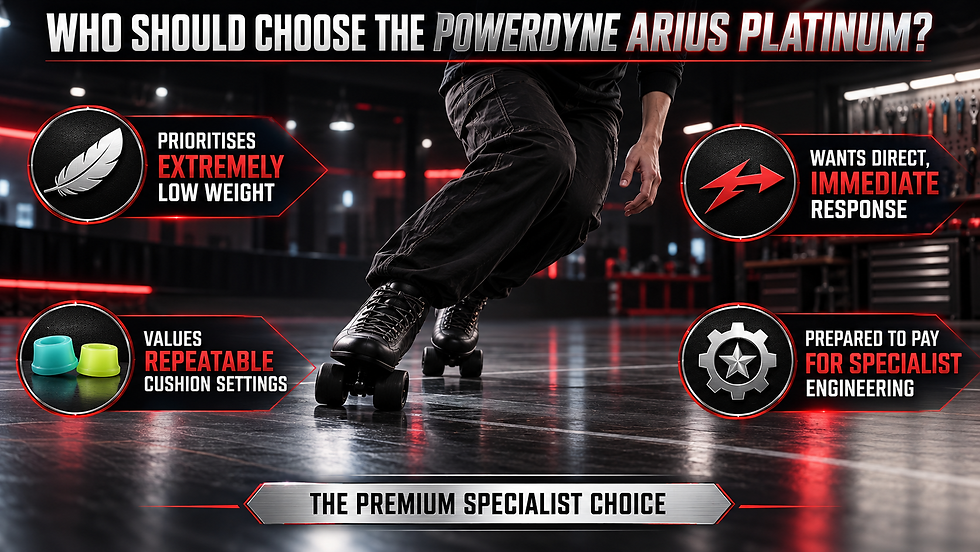
Choose the Arius if you want:
A genuinely different kingpin-free truck system
Very direct and precise response
A premium 6061 aluminium plate
Repeatable tuning through butterfly cushion selection
Four cushion sets included with the plate
Fewer conventional adjustment components
A plate built around axis pins rather than kingpins and pivots
The freedom to experiment until you find a highly personalised setup
One of the most distinctive high-end plates available
The Arius makes the most sense for an experienced skater who understands what they want from a plate and is prepared to spend time testing different cushion combinations.
It is harder to justify for somebody who simply wants “a better plate” without knowing what they want to change about their current setup.

Is the Arius Platinum Better Than the Avenger?
Not automatically.
The Arius Platinum is more technically unusual, significantly more expensive and manufactured as a premium precision plate. It can provide exceptional agility, stability and direct control when fitted with the right cushions for the skater.
The Avenger is far less expensive while still providing outstanding manoeuvrability. It also offers a style of adjustment that is easier to understand and can be altered in smaller increments.
For the majority of skaters, the Avenger Magnesium provides the better balance of performance, adjustability and value.
For an experienced skater who wants the Arius system specifically, rather than simply wanting an expensive plate, the Arius Platinum can justify its price.
That distinction matters.
If you have to ask whether the Arius is automatically twice as good because it costs more than twice as much, the answer is no.
If you understand how its axis-pin system and Split Butterfly Cushions differ from a traditional plate and that is exactly the behaviour you want, there is nothing else quite like it.

Final Verdict
The Sure-Grip Avenger is the sensible performance choice.
It is light, highly agile, deeply adjustable and exceptionally capable. The Magnesium version provides premium performance without reaching the price of the most expensive plates on the market.
The PowerDyne Arius Platinum is the specialist choice.
It replaces the conventional kingpin system with something genuinely different and offers a direct, precise skating experience that cannot be recreated simply by fitting softer cushions to another plate.
Neither plate is universally better.
Choose the Avenger if you want outstanding agility, conventional adjustment and strong value.
Choose the Arius Platinum if you specifically want its kingpin-free action, are willing to experiment with butterfly cushions and consider the unique skating experience worth the considerable additional cost.
Both plates are available from Pabloskates, with plate mounting and complete custom skate builds also available.
This comparison is based on my own experience of skating, fitting and maintaining both plate systems. Roller skating is highly subjective, and factors such as skating style, experience, body weight, boot choice, plate sizing, mounting position and cushion setup can all affect how a plate feels.
What works perfectly for me may not suit every skater. The aim of this article is to explain the practical differences and share my honest opinion, rather than declare one plate universally better than the other. Wherever possible, technical specifications have been separated from personal observations.
Browse our skate gear or get in touch to discuss your dream setup only at Pabloskates.com.
Skate Plates - https://www.pabloskates.com/plates
Pre-Built Retro Skates - https://www.pabloskates.com/skates
Skate Parts & Accessories - https://www.pabloskates.com/parts
Custom Build Enquiries - https://www.pabloskates.com/services
Phone/WhatsApp - 00447848287929
Email - mail@pabloskates.com

Comments